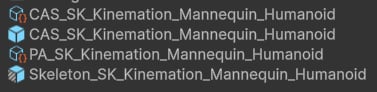
After you click Apply Preset in the setup wizard, CAS creates a set of assets in the current Project folder and modifies your character hierarchy. Understanding what was generated — and why — will save you time when you need to adjust the character later or connect your own gameplay code to the animation system.

Generated Assets

The following files appear in your Project next to the character model:

Character Animation Settings

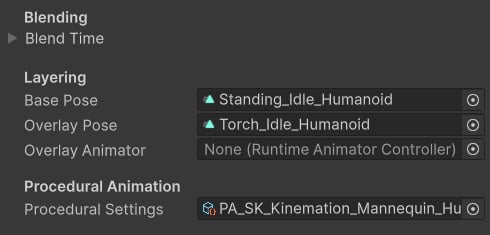
The CAS Settings asset (prefixed CAS_SK_) is the central data asset for your character. Open it in the Inspector to find:
  • Blend Time — configures blend-in and blend-out duration in seconds, plus the easing curve type used when transitioning between overlays.
  • Base Pose — the standing idle clip CAS uses as a reference for computing additive motion at runtime.
  • Overlay Pose — the clip representing the character’s current gameplay state (weapon, item, or body condition).
  • Overlay Animator — an optional Animator Controller that replaces the standalone Overlay Pose when you need multiple overlay states with transitions.
Keep the Overlay Animator lean — it only needs states that represent distinct item or body poses. Your main locomotion logic stays in the primary Animator Controller.

Procedural Animation Settings

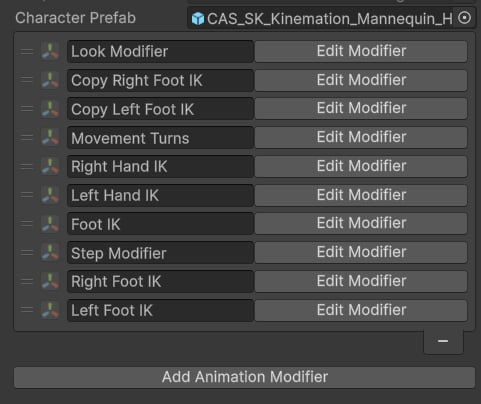
The Procedural Animation Settings asset (prefixed PA_) lists every procedural modifier that runs for this character at runtime.
  • Character Prefab — a reference to the root player prefab. Animation modifiers use this reference to locate your gameplay components (for example, reading velocity or aim angle via Property Bindings).
  • Modifier list — an ordered list of animation modifiers. The order defines the execution sequence, which matters for IK-based modifiers: a Foot IK modifier must run after the Copy Bone step that feeds it the animated foot position.
Modifier order is not arbitrary. IK features such as Foot IK and Step Modifier depend on data produced by earlier modifiers in the stack. Reordering incorrectly will cause IK to read stale bone positions.
To learn the purpose of each built-in modifier, see the Animation Modifiers reference page.

Character Skeleton Prefab

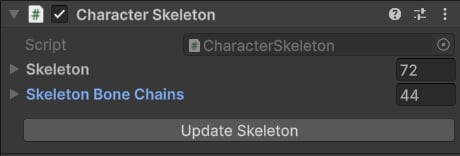
The Skeleton prefab (prefixed Skeleton_) is a Prefab Variant of your original model. CAS separates the skeleton from the main player prefab so bone data is always authoritative and easy to update. The CharacterSkeleton component is attached to the topmost bone in the hierarchy (typically named Root, Armature, or Skeleton). It stores the full bone reference table that CAS and procedural modifiers query at runtime.
Whenever you modify the character hierarchy — adding a camera socket, attaching a prop bone, or removing a bone — you must update the CharacterSkeleton component so its cached references stay valid.
Make all hierarchy changes (camera sockets, attachment points) inside the Skeleton prefab, not on a scene instance. This keeps the prefab as the single source of truth for bone structure.

Components on the Skeleton Prefab

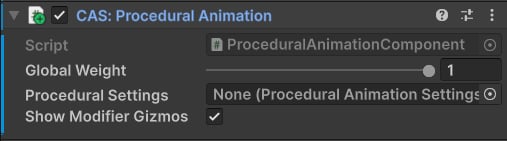
CAS attaches three main runtime components to the root of the Skeleton prefab.

Character Animation Component

This is the central runtime controller for the entire CAS pipeline. It is responsible for:
  • Loading and switching Character Animation Settings at runtime (for example, swapping from a pistol overlay to a rifle overlay).
  • Coordinating the Layered Blending and Procedural Animation components each frame.
  • Providing the public API for playing animations and triggering full-body pose blends from gameplay code.
See Character Animation Component for the full API reference.

Procedural Animation Component

This component manages the lifecycle of the procedural modifier stack defined in the Procedural Animation Settings asset. It creates modifier instances on Awake, updates them in the correct order each frame after the Animator has run, and tears them down on Destroy. See Procedural Animation for details on adding, removing, and configuring modifiers.

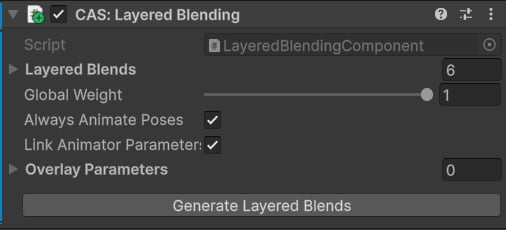
Layered Blending Component

The Layered Blending component is responsible for generating the final character pose each frame by combining:
  1. The Animator output — your main locomotion and action states.
  2. The Overlay pose — the current weapon or body-state animation.
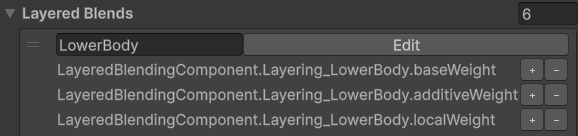
Layered Blends define which body regions are blended and which float parameters drive the blend weight. These float values are written by the active Animation Clip’s embedded curve properties at runtime — so each clip carries its own blending instructions. See Layered Blending for the full parameter reference and curve authoring workflow.

Player Controller Prefab

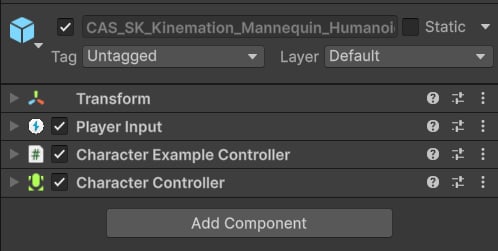
The Player Controller prefab nests the Skeleton prefab as a child and adds the CharacterExampleController script. This example script handles movement, action inputs, and prop management (torch, axe, barrel, gun). It is provided as a starting point and learning reference — review it before writing your own controller. See Example Content for a walkthrough of the example scripts.